See the consequences
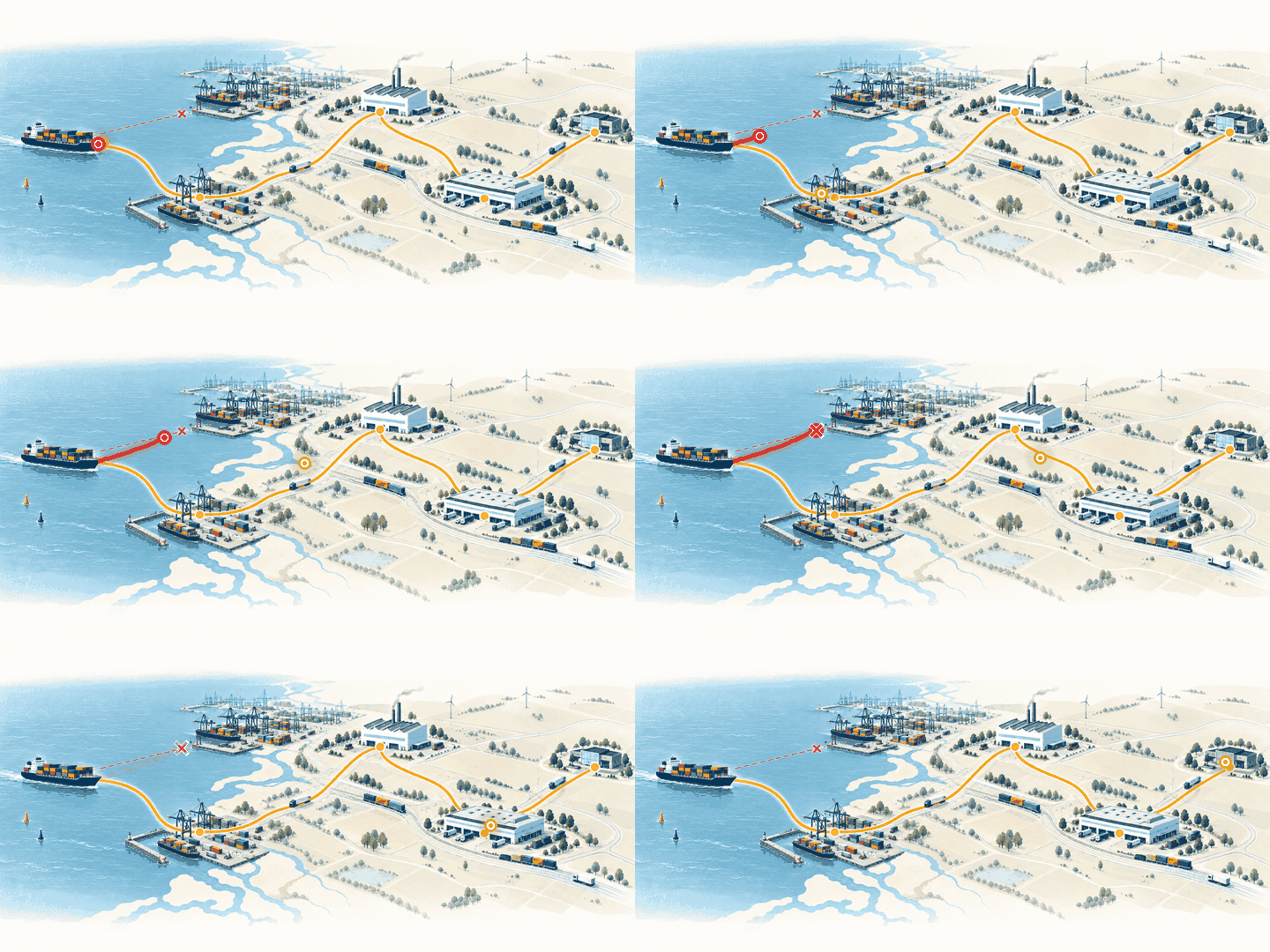
A late PO line changes material availability, which moves a production order, which puts a customer promise at risk.

 Contact
European application · European data residency
Aidecis is the decision intelligence layer for supply chain.
Aidecis governs every consequential supply-chain decision end to end: it sees the change, weighs the consequences across the chain, makes sure the decision is taken by someone, or something, allowed to take it, and proves what happened.
On top of SAP, your planning tools and every vendor's agents. It replaces none of them.
One chain, not one decision
A consequential decision rarely stays in one system or one team. One change moves through the chain, and each step opens the next, under its own authority.
A late PO line changes material availability, which moves a production order, which puts a customer promise at risk.
Every step is taken by the person, or the agent, allowed to take it, within the limit that applies.
One record across the systems, teams and vendors' agents the chain touches, linked to the outcome of the whole.
Every orange point is a decision: a planner books the reroute, your planning system moves stock, a carrier's agent changes the booking. Aidecis applies one set of rules to all three and keeps one record.
With enforced control, your own integration checks Aidecis's single-use grant before an action runs. Registered actors that write in their own systems, such as the carrier's agent, are observed and reconciled after execution.
What Aidecis is
Agent vendors now ship their own audit trail and override controls, each for their own agents. Aidecis is the layer across all of them: one set of rules for who may decide what, and one record of every decision, linked to its outcome.
Aidecis does not replace SAP, access control or AI model governance. It decides who and what may take each consequential decision, within which limits, before it runs: for your people, your own algorithms and every vendor's agents. Each decision then has one record, linked to its outcome, whichever system it ran in.
People, bots or both
Your company already runs software that decides: MRP runs that create orders, replenishment rules that move stock, planning tools that change schedules, and now AI agents. Aidecis brings your people, your existing bots and our agents into one visible decision chain, governs each of them with the same authority and evidence, and tells you when a decision should change hands.
A market scenario, not an Aidecis result: the WEF and Accenture report places most supply-chain domains at autonomy level 1 to 2 now, and expects them to reach 3.5 or more over the next five years and beyond.
Source: The Role of Start-Ups in AI-Enabled Supply Chain Resilience (WEF and Accenture, September 2026) Our analysis of the report
Aidecis moves each decision up that scale, or back down, one decision type and site at a time, on evidence. A decision moves up only when all six release conditions hold:
When one of them stops holding, the decision moves back down.
How far a decision can move up the scale depends on your maturity in that decision family: basic, digital, advanced or leading. For basic or digital organisations we propose reviewed assistance and bounded pilots, not bot mode.
When one bot's output becomes the next bot's input, an error can travel down the chain with no person in between. So agent-to-agent (autonomy level 4) is never switched on for a whole decision family. A single chain qualifies when all of these hold:
A closed process has fixed inputs, systems and outputs, and clear limits. Your confidence that a process is stable is where we start; replaying your own decisions is how we prove it. A breach at any step returns the whole chain to hybrid.
A person with the right authority decides. Agents can prepare the evidence and the options.
Human-to-agent · autonomy level 1, assisted
A bot proposes and a person approves, or the bot decides within a set limit and a person decides above it.
Agent-to-human · autonomy level 2, co-adaptive
The bot decides and acts in your system, only for reversible actions within limits you approve, with monitoring and a way to stop. Aidecis reads each action back.
Bounded agent-to-human · autonomy level 3, self-directing, for one decision type and site
Each bot is registered with its owner, its role in the chain, its limits and its version. It keeps its own logic; Aidecis governs what it may do.
A new algorithm version, a higher limit or a step that moves from a person to a bot is approved, dated and visible in the chain.
When a decision has become stable, Aidecis shows the evidence that it can move from people to a bot. When a bot drifts, it advises moving the decision back to people.
Two levels of control
A vendor's agent or your own MRP run often writes straight into the ERP, TMS or WMS with its own credentials. You do not have to change those write permissions to start. Aidecis covers both cases, and every decision record shows which level applied.
Aidecis issues a signed, single-use grant for exactly the approved action. With enforced control, your own integration checks that grant before it executes: without a valid grant, the action does not run. Use it where an action must not run unapproved: above a set amount, or where it cannot be undone.
What it proves: the exact action was authorised before it ran
An agent or algorithm that writes in its own system is detected afterwards from that system's change records, matched against its registered role, limits and mode, and recorded. If it went outside them, it is flagged within minutes for its owner to act on. Observed control does not stop an action. It makes sure no action runs unseen.
What it proves: what ran, by whom, against which role and limit, within minutes after the fact
Register the actors and change no permissions. Measure how often their writes fall outside role or limit.
The deviation rate per decision type shows where enforcement is worth the extra step, and where observing is enough.
Move an actor to enforced per decision type, for example for every write above a set amount. Aidecis can recommend it; you decide.
S-CLAIM, the Supply Chain Learning AI Model
S-CLAIM recognises the decision behind a signal, warns before friction and explains who decides and why. It is trained on a decision library and rules Aidecis owns, never on client data.
Already run a decision platform?
Aidecis does not compete for a planning or decision platform's logic. It takes the platform in as one actor in the chain and governs the steps, the authority and the outcome around it.
How the layer works
Every consequential decision runs through the same seven steps, whoever or whatever takes each one.
Detect a changing situation from a signal in the systems Aidecis is connected to.
Gather the context the decision needs, and say which facts are missing or stale.
Identify the commitments affected, the consequences downstream, and who holds the authority to decide.
Weigh the options against your objectives and constraints, and explain the recommendation with its evidence.
Take the action when it is within delegated authority, or put a decision-ready case before the person who holds it.
Check every action against the same authority, including those people, bots or other vendors' agents took directly in the systems.
Record what was considered, approved and done, link the outcome, and use that history to tune the policy and the authority behind it.
Procurement and supply chain are the starting point
In operations, a decision is rarely local. A rerouted shipment changes production cover. A schedule adjustment affects material availability. A supplier substitution touches quality and customer commitments.
Aidecis makes that impact explicit before execution, and reuses a proven decision at other plants, warehouses, lanes and regions.
Follow one decision chainPrice notice → envelope check → buyer or category-manager authority → approval where needed → PO or contract amendment → margin outcome.
Specification, source approval and cost thresholds held together as one accountable decision.
Delay notice → inventory cover → authority check → regional approval → controlled re-route → service outcome.
One product, two operating environments
Aidecis manages policies and decision logic in its European cloud. Aidecis never writes into your systems. Your people, systems or bots execute the approved action, and Aidecis reads each execution back and reconciles it against the approval. SAP stays your single source of truth. With enforced control, your own integration checks Aidecis's single-use grant before it executes: without a valid grant, the action does not run.
Benefits
Try the product
Follow a cocoa delivery for the fictional De Boer BV: an AI agent spots the delay and proposes a fix, your rules decide who approves, and every step stays on record. Recorded from a real run of the product.
Opens in its own tab and works on your phone. Choose your view: planning, spend, or IT and risk.
Decision infrastructure for operations at scale
Aidecis turns operational data into decision workflows your teams can evaluate, govern and deploy across sites, regions and warehouses.
Prove a workflow against evidence. Put it into production with clear controls. Extend it across your network through certified configurations.
Subscription €45,000 per year, including the first site and two regions. Indicative, excluding taxes. Implementation is scoped to the workflows, integrations and operating footprint.
The way in is the decision replay assessment: four weeks, fixed fee, read-only on your own SAP purchasing history. Aidecis replays your decisions against your policy and authority, and shows the funnel from SAP changes to cases, cases per approver per day, gaps in the authority matrix, and software that writes without being registered.
You leave with a clear view of what a shadow run and governed execution of one decision would take, and what a production rollout requires.
Decision replay assessment: €16,000 to €24,000 (10 to 15 days).
Estimate the investment for your networkKeep decision logic, data and workflows in a shared registry, with a clear record of what is configured and approved.
Build evaluation sets, replay decisions and produce certification evidence before a workflow reaches production.
Deploy certified workflows across sites and regions while keeping local configurations within defined controls.
Give operational, technical and partner teams access without making user count the pricing meter.
A pilot is ready when ownership, data access, procurement and a measurable decision are in place. At the assessment we check five conditions with you. A pilot without a named owner does not start.
We ask A go or no-go within 4 to 8 weeks of the assessment.
We offer A fixed-scope, fixed-price evidence sprint.
We ask A named executive owner, and a process owner for each decision type.
We offer Weekly progress in the decision record and the value record.
We ask A short pilot contract, a standard DPA and balanced IP terms.
We offer The pilot contract, DPA and subprocessor list, ready to sign.
We ask Agreement that the first slice is read-only and that shadow is a valid result.
We offer Aidecis never writes into your systems, and nothing moves beyond read-only before the agreed gates are passed.
We ask Real cases and, if the pilot succeeds, a reference.
We offer Founding-client terms.
Every pilot is anchored in one decision type and one hard measure in your own terms: response time to a disruption, premium freight spend, stockout hours or price variance.
A vendor-trust pack for your procurement, security and risk teams is available on request: security, privacy and AI-governance documentation mapped to ISO/IEC 42001 and to your EU AI Act deployer duties, with our prices and an architecture walkthrough.
Every subscription carries a continuity package, so your governance does not depend on a young vendor.
Everything you own, in open formats, at any time and at the end of the contract.
An open-source ledger verifier, so you or your auditor can check an export without Aidecis. Read its source code on GitHub.
Source code of the control kernel and the gateway, held by an escrow agent.
Agreed days at the published day rate to move your policies and records to the platform you choose.
Option: a dedicated control plane for your organisation.
Aidecis works with your team to scope the first workflow, measure it against a baseline, and plan its path into production. As the evidence and operating case grow, you can extend the platform to more workflows and locations.
European by design
European supply chains run across sites, languages, jurisdictions and highly specific local operating rules. Aidecis is designed around that reality: local authority is visible, policy reuse is governed, and an operating practice is never pushed enterprise-wide without the right conditions and acceptance.
Product design and deployment approach centred on European industrial operations.
European hosting and regional data residency are core deployment principles.
Policies can travel with evidence; local sites remain accountable for activation.